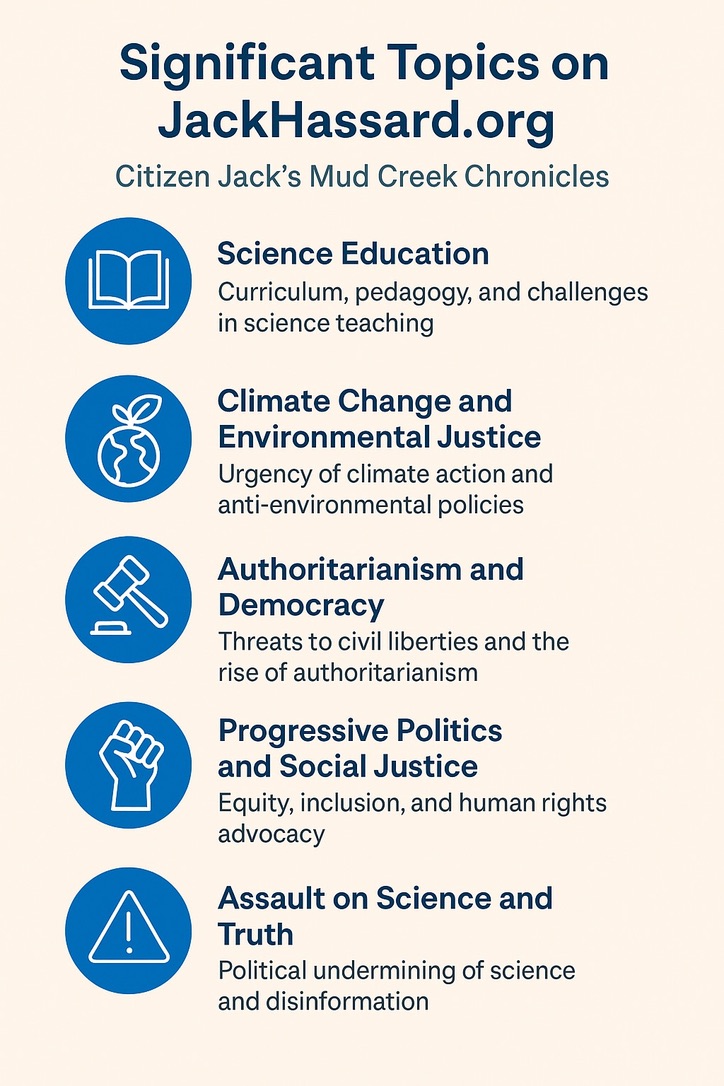
The author reflects on their evolving beliefs about American democracy in the context of Trumpism, questioning whether institutions can truly safeguard democracy or if the responsibility lies with the citizens. They explore how Trump’s presidency has reshaped governmental structures and politics through grievance, which can polarize and dehumanize political opponents. While acknowledging the threats to democratic norms, the author also recognizes the ongoing resistance within society, emphasizing that democracy requires active participation and vigilance. Ultimately, the work serves as a personal commentary on the current state of American democracy and the necessity for collective action and awareness.
Jack Hassard published a letter in the Marietta Daily Journal arguing against the use of Wheeler High School as a political venue for President Trump’s campaign alongside local candidates. He emphasizes that public schools should remain politically neutral to serve the entire community, promoting education over partisan politics.
The Trump event at Wheeler High School in Cobb County serves as a notable example of the erosion of boundaries between public institutions and partisan politics. Initially framed as a policy occasion, it devolved into a campaign rally, showcasing political endorsements and attacks. The transformation exemplifies how schools are increasingly utilized for political mobilization. As demographics in Cobb have shifted, Wheeler High has become a symbol of active citizenship, where diverse students engage in democratic processes. This event highlights the importance of maintaining public schools as civic spaces free from partisan influence to preserve democratic trust and community unity.
This post supports a civic inquiry seminar based on inquiry and cooperative learning strategies. It highlights the importance of identifying five warning signs of democratic erosion identified by historian Ruth Ben-Ghiat: electoral manipulation, weaponized government, press intimidation, normalization of extremism, and transfer of power crises. The content draws parallels between these signs and recent developments in the United States, particularly under Donald Trump. The discussion emphasizes the necessity of recognizing these signs to safeguard democracy, as it has eroded incrementally rather than collapsing outright, showcasing the risks tied to political actions and societal complacency.
Randi Weingarten’s “Why Fascists Fear Teachers: Public Education and the Future of Democracy” argues that threats to public education undermine democracy itself. Weingarten uses historical examples, notably the resistance of Norwegian teachers during WWII, to illustrate that teachers promote independent thought and civic responsibility, making them targets for authoritarian forces. She emphasizes that public schools are vital for nurturing informed citizens and critical thinking. Though critics may challenge her perspectives, her call to empower teachers as intellectual leaders highlights their crucial role in strengthening democracy, particularly amid current educational debates.
In reflection of the United States’ 250th anniversary, four essays explore the essence of American identity. They discuss themes from Supreme Court rulings on birthright citizenship to the Declaration of Independence and envision a letter from the future commenting on this pivotal year. The final essay delves into personal narratives of immigration and belonging. Central to the reflection is the question of what America will bequeath to future generations—adherence to constitutional principles or yielding to political ambitions. The essays urge a deeper understanding of patriotism, emphasizing the importance of prioritizing democratic values and the enduring legacy we create today.