
How can textbooks be used so that students will read them for meaning and understanding? A partial answer to this question lies in how we think students learn. Let's accept the cognitive psychologist's assertion that human learning is dependent on the individual's active interaction with the environment, and that new learning must be tied to what the student already knows. If the textbook is to be one of the "environments" which the learner will interact, then we must find a way that involves the student actively with the textbook. Simply saying, read pages 20-30 for homework will not work. Critics of textbooks charge that:
...the textbook is weak in that it offers little opportunity for any mental activity except remembering. If there is an inference to be drawn, the author draws it, and if there is a significant relationship to be noted, the author points it out. There are no loose ends or incomplete analyses.
Although textbooks have become more visual, there is still the problem that "few users of textbooks, instructors and students alike, are literate enough to derive full value from the textbook's illustrations."
In order for students to read for meaning and understanding, a teaching strategy must be employed that actively engages them comparing what they already know to the new material, as well as involving them in processes such as predicting, inferring, hypothesizing, summarizing, drawing conclusions, and discussing.
Two strategies will be presented here that have been used in science classrooms, and have been shown to be effective. The first is called the K-W-L procedure, and the second we shall refer to as the Survey-Read-Map-Check procedure.
K-W-L
According to Donna Ogle, the originator of K-W-L, prior knowledge is an integral aspect of how we interpret what is read, and what students will learn from reading. Unfortunately, most science teachers fail to make use of what their students bring to a topic. The K-W-L procedure supports the main assertion of cognitive psychology that the student preconceptions of science need to be determined prior to learning new concepts.
The procedure is comprised of three cognitive steps: assessing what I Know, determining what I Want to learn, and recalling what I did Learn. Ogle has developed a K-W-L strategy sheet (Figure 1) which students can use as they "read" a section of the science textbook.
1. K-What we
know W-What we want to
find out L-What we learned
and still need to learn
2. Categories of information we expect to use
A.B.
C.
D.
E.
Briefly, here are the essential characteristics of each step in the K-W-L procedure and an example of a lesson plan on "earthquakes" (Figure 2).
Step K---What I know. This is a brainstorming session in which students express what they know about the topic. What the students know can be written on the chalkboard, on chart paper, on written by students working in small groups. The focus at this stage should be specific. If the students are going to read a section in their text on earthquakes, ask "what do you know about earthquakes," not what do you know about natural disasters, or have you ever been to San Francisco? Focusing on the content will help bring out the cognitive structures of the student's prior knowledge.
A second part of the K-step is to have the students categorize the information they have generated during the brainstorming session. For example, in the lesson plan below on earthquakes, the teacher might suggest that students group their information in the following categories: causes of earthquakes, how earthquakes are measured, and damages caused by earthquakes.
Step W-What do I want to learn? This step helps the students anticipate the reading that is to come, and helps the students focus on what they want to learn from the reading. This step should be done as a group activity. The teacher should ask the students to write down on the K-W-L worksheet questions that they are most interested in having answered as a result of the prior discussion and brainstorming session. Once the questions are written, the teacher might have the students share their questions in small groups prior to actually reading.
Step L-What I learned. Students can write down what they learned on the K-W-L strategy sheet. They can also check to see if their questions were answered, and if some of their prior knowledge was confirmed. Students should work in small groups and discuss their questions to determine if their questions were answered.
Objectives: 1. to describe how
earthquakes are caused 2. to predict the
effects of an earthquake Reading:
Students will read Chapter 19. Earthquakes in Focus on Earth
Science (Merrill Publishing Company, 1989): 411 -
428. Procedure K:
What do students already know about
(earthquakes)? 1. Pairs of students
brainstorm and record what they know about
earthquakes. 2. Pairs of pairs
(groups of 4) share lists and prepare a composite
list. 3. Groups of four
share with the whole class by taping lists on the walls of
the classroom. Teacher focuses on the lists, and asks groups
of four to categorize the information: topics include at
least---causes of earthquakes, damage caused by earthquakes,
earthquake waves, and how earthquakes are
measured. 4. Teacher asks
students how they got their information about earthquakes.
This last procedures personalizes student knowledge, and
acknowledges the sources of students' prior
knowledge. W:
What do students want to know about the
topic? 1. Each group of
four develops four questions about the topic. 2. Teacher records
these questions on the board. The teacher can elaborate on
the questions, perhaps selecting two or more that seem
interesting to the students. L:
What did students learn about the topic? 1. Group circles
information on the master list that the text
confirmed. 2. Information is
crossed off that text refuted. 3. Students
contribute to new list: What we learned! 4. Teacher goes
around the class and asks each student to indicate by
(thumbs up/thumbs down) if their question(s) were
answered. 5. Teacher asks each
group to make a map or a web of the main ideas and
supporting secondary categories of what they learned from
the reading.
Survey-Read-Map-Check
Another procedure which is designed to help students read for meaning involves four steps: surveying, reading, mapping and checking. The process is very similar to the K-W-L, and after studying both procedures, you might want to combine elements from both to personalize your approach to helping students read science textbooks. Let's examine the four steps in this reading procedure.
Step 1 Surveying: Surveying involves skimming the text passage and specifically students do the following: (1) look at the title; (2) look at the headings and subheadings throughout the reading, (3) read the introduction and conclusion or summary, or the first and last paragraph of the reading, and: (4) after surveying, write three things they expect to learn from the reading. Surveying should be done in small groups, and the results shared with the whole class.
Directions: Take two
to three minutes to survey the chapter on "weather and
climate" (or any other chapter) using the steps listed
above. After you have surveyed the chapter, write three
things you expect to learn from the chapter. I expect to learn:
(following are samples of what students might
write) 1. What causes
the weather. 2. The different
kinds of clouds. 3. Tornadoes,
hurricanes and other severe storms.
Step 2 Reading: During this step the students not only read the assigned materials, but search for the main ideas and supporting details. Thus it is important to break reading assignments down in to manageable chunks. Students need to informed that the main idea is the most important idea of a section and the rest of the paragraph of the section is built around the main idea. Supporting details explain and amplify the main idea.
|
Directions: Find the main idea and supporting details in this paragraph: "Hurricanes are tropical cyclones that form over oceans. They usually form in latitudes between 5 and 20, and move toward higher latitudes. Air over tropical oceans is very warm and humid. Sometimes centers of very low pressure develop with a rapid inflow of air, forming a nearly circular storm. Air near the center is forced aloft and flows outward at upper levels. Wind speed increases as the storm develops. When wind speeds reach 120 km/h the storm is a hurricane. An eye forms at the center as air sinks and is warmed by compression." Main idea: Hurricanes are storms that form in the tropics. Supporting details: they form between 5 and 20 latitude; must have winds greater than 120 km/h; an eye forms |
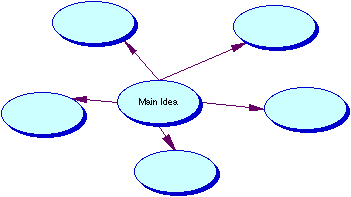
Step 3 Mapping: Taking notes the third step in this reading process. Mapping is an extension of the previous step, however in this procedure the students make a map of the information they are reading. The student writes the main idea or concept in the center of a sheet of paper and circles it. Supporting details and ideas are written and connected to the main idea.
|
Directions: Find the main idea in the section you are reading. Write it down and draw a circle around it. Write supporting details on lines connected to the main idea.
 |
Step 4 Checking. The final step in this reading process is to check what the students have learned. Checking is a process to help students identify and recall the most important points in the reading. In this step the students ask themselves: What is the most important idea in that I learned in this section?
Directions: Review
with your partner the section you read and identify the most
important idea in the section. Be prepared to defend your
selection.
Helping students read for meaning and understanding can be the result of creative lesson planning, and acknowledging that there is process for comprehending the information in science textbooks. K-W-L and Survey-Read-Map-Check are two processes that have been shown to be effective.