
Thelen suggests that science teachers not preteach new vocabulary words. If indeed the words are new, then students should be engaged in learning activities to construct knowledge about these new words, most of which are science concepts. Instead, she suggests that science teachers reduce the number of vocabulary words that students need to learn, and use vocabulary reinforcement activities to help enhance vocabulary development.
One technique that science teachers can use to reduce vocabulary is to use a structured overview---a sort of visual overview showing the relationship among science concepts. In this approach the teacher would identify the vocabulary of the learning activity, chapter or unit, and arrange the words in a scheme that depicts the relationships among the concepts. The structured overview (much like a concept map) is then presented to the students, and used to find out what they already know about the concepts and terms. The structured overview or organizer can be used as students explore the topic (Figure 1).
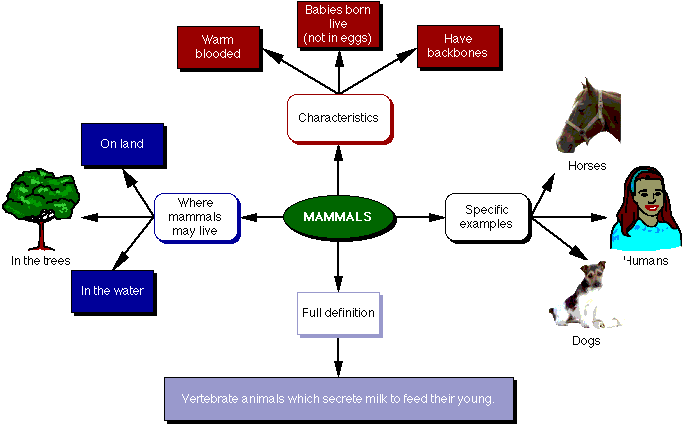
Figure 1 Structured Overview of Mammals
Most science textbooks identify by means of bold print, underline, or italics the key vocabulary words in a chapter. Students need to learn how to interpret meanings by reading about the concepts by focusing on context clues. Context clues are the sentences and phrases in the text surrounding the vocabulary word. Reading guides might suggest an activity after the student has read a passage in a text, or might ask the student to read a passage and then write the meaning of several vocabulary words.
For example, you might have the students read a passage such as the one shown below, and then write the meaning of the words shown beneath the passage. The meaning of the words will be based on the student's prior knowledge as well as the contextual clues in the passage.
All organisms are composed of and develop from cells. Some organisms are composed of only one cell. These organisms are called unicellular organisms. Most of the living things you see around you are composed of more than one cell. Such organisms are called multicellular organisms. Multicellular organisms usually arise from a zygote. The process by which a zygote becomes a mature individual is called development.unicellular ________________________________________________________
multicellular ________________________________________________________
development ________________________________________________________
Figure 2 shows how a reading guide can be useful in helping students make use of some of the context aids in the text to enhance vocabulary and concept development. In this case the teacher is selecting and identifying what is important and telling the student to focus on these aspects of the chapter in order to develop conceptually.
Paragraph 10 (Yes,
that's right, Paragraph 10.) Read paragraph 10 and keep it
in mind as you follow the exercises on this sheet. Now
proceed to: Paragraph
1. Draw
a picture of a light spectrum. b. Why do they
call it a rainbow pattern? c. If you take
the orange out what color will replace it---black or
white? Paragraph
3 a. Read sentence
1 b. Look at Fig. 5.8
and read sentence 1. c. 1. Does it look
like a rainbow? d. List 3 things
that are the same or different between 5.8 and a
rainbow. 2. 3.
a. Does it
look like a rainbow?
1.
A number of types of vocabulary activities can be used to reinforce and extend students' vocabulary development. These include categorizing, word puzzles, matching, magic squares, crossword puzzles, and various writing forms (see ahead in the section on science writing). Here are some examples.
There are five words
in each section below. Cross out the two words in each you
feel are not related to the others. Explain the relationship
by titling each group. amino acids
waste energy
storage water
food enzyme
pocket protein
contractile 2.______________________ waste storage food pocket contractile
Using the clues on
the next page, complete the spelling of each
word. 1.-----S- 2.
-----O---- 3.
---U----- 4.
-R-------- 5.
----C------- 6.
--------E------------ 7.
-----S--- Clues: 1. Source of
chemical energy in all animal cells. 2. Plant energy
source. 3. Reaction
involving gain of electrons. 4. Conversion of
organic acid. 5. One place where
reaction for liberation of energy takes place. 6. Key substance
which occurs in every living organism and cell. 7. ADP