
Except for the action project, most of the values clarification strategies are single lesson approaches to teaching STS. An alternative strategy is to develop an STS or EE module that would be taught as part of an existing science course. This approach seems to be more powerful. Rather than adding a day on acid rain, or global warming, or endangered species, the module approach advocates that teachers identify a significant science-based social issue and use the learners interest in the topic as basis for two to four week module within the existing science program.
Although there are many commercially available STS modules on the market, the purpose of this section is outline criteria that you might use to develop your own STS module. According to Wiesenmayer and Rubba, environmental educators developed a model of instruction in which students develop the ability and desire to take responsible environmental actions. The model, "Investigating and Evaluating Environmental Issues and Actions Skill Development Modules," was developed by Harold Hungerford and his colleagues at the University of Southern Illinois.The model went well beyond the environmental awareness level and achieved success in getting students involved in action taking. Details of the model are described in the STS Curriculum Examples section of this chapter. Rubba and Wiesenmayer adapted the environmental model to STS and proposed four levels or stages of activities in developing an STS module. The goal of any STS module would be to "aid citizens in developing the knowledge, skills and effective qualities needed to make responsible decisions on STS issues, and to take actions on those decisions toward issue resolution." The levels of activities include: Level I: the STS Foundations Level; Level II, the STS Issue Awareness Level; Level III, the STS Issue Investigation Level; and Level IV, the STS Action Skills Development Level.
Goal of STS
Instruction: Make Responsible Decision and Takes
Action
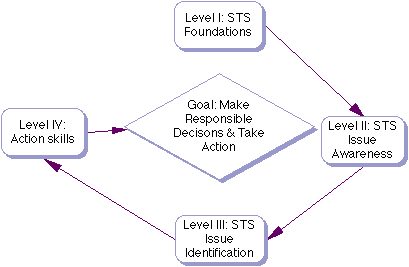
The starting point for an STS module is a list of possible social issues that might interest the students. Here are some suggestions:
An STS module on any one of these topics should normally take between three and four weeks. The time spent on the unit should be divided among the four levels of instruction. To help you in planning an STS module, following are brief comments about each level.
STS Foundations. At the foundation level, you must identify the concepts that are related to the issue in question, e.g. acid rain, oil spill, AIDS. However, in the STS approach the concepts that should be identified are those that cut across the traditional disciplines of Earth, life and physical science. Candidates for this would include unifying themes such as change, field, interaction, model, system, or energy transfer, evolution, stability, patterns of change, systems and interaction, and scale and structure. For example, in a module on oil spills, STS foundation concepts might include system, change, energy and interaction. If students were investigating the 1988 Alaska oil spill they might explore the interaction effects of oil on the ocean-beach system
Selecting unifying concepts and themes leads students to new ways of thinking. Students learn to connect ideas---to think holistically. Facts and concepts are not taught in a linear fashion (Concept 1 1 Concept 2 1 Concept 3), but are taught in the context of an issue. In this light concepts are seen as being interdependent and interdisciplinary.
Finally students are engaged in exploring major ideas not for their own sake, but as useful constructs in helping them solve relevant social and global problems.
The foundation level should also show the students how science and technology interact, and their interdependence
STS Issue Awareness. A series of lessons should be planned to help the students realize how STS interactions result in controversy surrounding an issue. The lessons would help students examine a) all sides of the issue, b) beliefs and attitudes affecting the issue, c) alternative solutions to the issue. For example in module on risk from smoking, students might explore:
• the negative physiological effects of cigarette smoking• the nature of addiction and the difficulty experienced by many smokers who attempt to quit but can't.
• the efforts made by the cigarette industry to attract young people between the ages of twelve and eighteen years to smoking.
• the attempts of the cigarette industry to keep important information about the health hazards of smoking secret.
Values clarification and awareness activities such as value dilemma sheets, STS action dramas, case studies, and voting are useful tools at this level.
Issues Investigation. The issues investigation level is similar to the action project discussed in the values clarification section. At this level students are taught how to investigate an issue. It would involve training with problem identification skills including problem identification and statement, use of secondary sources, data collection via primary sources, data analysis, and drawing conclusions. The newly acquired skills would be applied to an investigation of a real local issue.
Action Skill Development. Taking action on an issue involves an understanding of new skills that many students are unfamiliar with. Wiesenmayer and Rubba suggest that lessons should be designed to help students with consumerism, legal action, persuasion, physical action and political action. They also point out that students should have the opportunity to apply these skills.
Wiesenmayer and Rubba found in a study of seventh graders, that an STS module that employed all four levels promoted greater understanding of STS, and responsible action on an STS issue (trash disposal).